Planning Instruction and Assessment
The primary focuses of my content are persuasion and identity. These lessons will ask students to deepen their understanding of the concept of identity and begin to think about what makes up their identity. Furthermore, students will be asked to consider what role they themselves play in shaping their identity, as well as what role outside forces play in that same process, and how multiple peoples’ identities interact to create a community. Using this new, deeper understanding students will carefully consider visual instances of purposeful persuasion, from history and the present. Students will analyze how these images draw upon the audience’s sense identity and community, as well as other persuasive techniques, and consider what effect they may have on that audience.
This deeper understanding of their and others’ identity and ability to analyze attempts at persuasion will allow students to sift through the myriad of messages targeted at them every day, carefully consider the creator’s intent and desired message, and react to that information as an informed citizen and consumer. Students will also be able to metacognitively reflect on their ever-changing identity and how it is constantly shaped and reshaped by a variety of influences, experiences, and interactions in their world. Additionally, they will be able to take their understanding of identity, as well as what defines a community, into a variety of other disciplines, especially the Social Sciences and History, in which various peoples' identity and sense of belonging play an integral role.
Knowledge of Students to Inform Teaching
Students have previously covered the topic of persuasion and persuasive techniques in Language Arts class this school year as part of a larger instructional sequence on author’s purpose. (The students received instruction on three main author’s purposes – to persuade, to inform, and to entertain with higher achieving students receiving instruction in the distinction between informing and describing, and entertaining and creating a narrative.) Students therefore had previous knowledge of several persuasion techniques and had had previous opportunities to consider an author’s or creator’s motivation. Students are also encouraged to consider an author’s motivation throughout their Language Arts instruction, especially during whole-class read-alouds and resulting discussions on topics such as themes, implied messages, and word choice. However, students have had no known instruction on the topics of identity and communities and these concepts were not a part of their previous discussion on persuasive techniques.
Generally, all the students included in this sequence of instruction have the ability to read and write at or near grade level. A handful of students, mostly in the 7th grade, have some trouble with spelling or writing out longer pieces of text. Some of these students have trouble decoding sounds and translating those sounds into written words. Others have difficulties with writing related to learning disabilities. However, based on previous assessments through the school year, all students are expected to be able to complete the Facing History propaganda analysis guide that will be used, which requires around three sentences of sustained writing. Expectations may need to be adjusted for the writing portion of the summative assessment for some students.
The subject matter of this learning sequence is extremely relevant to the adolescent cognitive, social, and emotional development, however that may mean that the material may seriously challenge students in these arenas. (McLean & Mansfield, 2012) In these years of development (twelve- to fifteen-years-old) students are beginning to become aware of their personal identity and the impact they as individuals make on other individuals and groups. They tend to feel a strong connection to the various communities they are part of, although each student will identify with different communities and value some (perhaps a small friend group) more than others (perhaps their school community). (Bogard & Sherrod, 2008) However, they may not yet be aware of the ever-changing nature of their identity and their relationships with others and as a result may struggle to recognize and analyze identity changes in characters and themselves. They may also not be aware of the degree to which interactions with other people and greater systems affect their identity and personal perceptions, and so may have difficulty recognizing these affects in their own lives and in characters’ lives. (Huang, & Stormshak, 2011)
Beyond the ability to recognize these concepts in themselves and others, students of this age may also not have the social and emotional skills to effectively discuss these difficult, inherently personal topics, especially with peers who are also struggling to communicate in similar ways. Additionally, the potential for accidentally offending peers is high. (McLean & Mansfield, 2012) Because of all these potential issues, communication about or discussion of these concepts may have to be highly scaffolded and some practices to help sustain personal boundaries may have to be put in place by the teacher.
With all these factors in mind, the teacher will use two categories of data as pre-assessment for planning. The teacher will use assessment data from previous instruction on author’s purpose and persuasion. The general post-assessment of the author’s purpose unit indicated that 22% of 7th grade students and 29% of 8th grade students did not achieve adequate understanding of the material, according to teacher-set expectations. Broken down by section, 27% of the all 8th grade section, 14% of the all 7th grade section, and 34% of the 7th/8th grade split section (with an almost equal distribution of 7th & 8th graders) did not meet expectations. Three of the six students in the 7th grade section with identified learning disabilities did not meet expectation on this assessment. In general, students had more success on formative assessments of understanding of specific author’s purposes, especially persuasion. On a formative assessment of persuasion alone 10% of students in the all 8th grade section and 20% of students in the 7th/8th grade split section did not meet expectations. However, the all 7th grade section struggled considerably more on the specific persuasion formative assessment, with 55% of student not meeting expectations (additionally, five of the seven students with identified learning disabilities in this section did not meet expectations).
This complex set of data may be the result of several factors. In previous instruction the idea of persuasion was pushed beyond simple identification (unlike the other two sub-categories) and into understanding, identification, and application of specific strategies used to persuade an audience. The teacher used a variety of media to demonstrate the use of persuasion, including modern advertisements. The data suggests that the skills of identifying and applying persuasion techniques may have been challenging for many learners (hence the all 7th grade sections low success rate) but the content used to present and practice these skills may have been engaging for higher achieving learners who were academically prepared to take on the task (hence the higher success rate of the higher achieving 7th and 8th grade students). The data overall indicates that the all 7th grade section of students will need more scaffolding and perhaps slower pacing throughout this series of lessons. The data on specific students across all three sections also shows the teacher which students may need additional support during these lessons.
The other data the teacher will use to help inform assessment are scores from the winter session of the Northwest Evaluation Association Measure of Academic Progress (NWEA MAP). Although data from the winter session may be a bit outdated, it is the best available. Unfortunately, the spring session of NWEA MAP will be taken by students directly after this unit of study, and although the Illinois Standards Achievement Test (ISAT) was taken directly before, the resulting scores will not be available to inform this instruction. Students NWEA MAP scores will help to inform the teacher of students’ general academic progress in the Language Arts and help target students who may need additional assistance throughout the learning series. The winter session NWEA MAP data indicates that 28% of students in the all 8th grade section, 27% of students in the 7th/8th grade split section, and 53% of students in the all 7th grade section, (100% of Special Education students tested) are not performing at grade level on a general assessment of Reading Skills. This data further indicates that the all 7th grade section will need more scaffolding and slower pacing than their peers during these lessons and helps the teacher to identify specific students who will probably need specific support.
Using two sources of data also presents the opportunity to compare same-student performance across two measures. The teacher compared NWEA MAP performance to performance on teacher-generated formative and summative assessments and took notes on serious discrepancies in comparative performance, especially when students scored poorly on in-class assessments, but met or exceeded standards on the NWEA MAP test. The teacher identified at least one and as many as five students who met this criteria in each section and will pay close attention to these students’ performance throughout these lessons and scaffold as necessary.
Description of Texts Used
In the first lesson in this series that addresses identity, the class will read The Bear That Wasn’t by Frank Tashlin (New York Review Children’s Collection, 1946). The Bear That Wasn’t tells the story of a forest bear who accidentally finds himself in a human factory and is mistaken for a “silly man who needs a shave and wears a fur coat” by a factory foreman. He spends the a great deal of the book trying to convince various characters that he is in fact a bear but eventually ambivalently accepts his new given identity as a man. At the end of the book the bear internally wrestles with his identity as man or bear. On the surface the book is written, drawn, and bound like a typical children’s book, but a closer inspection reveals deep and complex content, witty and beautifully detailed illustrations, and content that offers great potential for high-order discussions. The professional development and curriculum organization Facing History & Ourselves has also created a video version of the book. A link to the text and the video can be found following the plans for this lesson.
The second lesson of this series, which addresses the concepts of “we” and “they” will feature a reading of “The Sneetches,” from The Sneetches and Other Stories by Dr. Seuss (Random House, 1961). In this well-known story, a group of creatures, called sneetches, with star shapes on their bellies socially dominates a group of sneetches without stars. Early in the story strange man comes into town and offers to give stars to those without so that they can be part of the dominant, “better” group. However, instead of this change uniting all the creatures, it makes those who originally had stars angry and inspires them to remove their stars, preserving their physical distinction and their status as better. A flurry of star adding and star removing begins and continues until no one can tell who originally had star and who did not. Eventually everyone becomes equal and the sneetch populations unite. A cartoon version of the “The Sneetches” was produced and is widely available online. The cartoon stays extremely true to the original story in general theme and content, as well as specific wording. The cartoon maybe used in this lesson as well. A link to the text and the video can be found following the plans for this lesson.
Also, in the second lesson the poem “We and They” by Rudyard Kipling, which speaks directly to the theme of artificial distinction and othering raised in “The Sneetches.” will be used, along with a graphic organizer created by the professional development organization Facing History & Ourselves.
Invaluable inspirations to use these texts, as well as additional curriculum resources were provided by Facing History & Ourselves.
Supporting Learning in English-Language Arts
The teachers understanding of students prior learning shows that the majority of students have an understanding of author’s purpose and persuasion more generally, but a sizable minority of students struggled with these skills during previous instruction. The teacher’s understanding of adolescent development, as well as a personal understanding of her students, indicates that deeper discussion of this content might be difficult for many learners. Therefore all parts of this instructional series will need to be carefully scaffolded to lead students to success. The teacher will also need to provide many examples, personal, non-personal, and fictional, of new concepts and new analysis techniques to give students multiple opportunities to assimilate new ideas into various schemas (e.g., what identity and community mean, how they are shaped, why persuasion is used, how persuasion is accomplished).
The three lessons and project-based assessment discussed here are sequenced to make assimilation of the new information presented into current schema as easy as possible and therefore make learning as effective as possible. Knowing that students inherently have personal experiences that relate to identity and are very likely to be thinking about identity (although perhaps not with academic vocabulary), the teacher chose to put that lesson first in the sequence. The teacher believes that the subject of identity may be seen as “fun” and engaging, and therefore may not be perceived as particularly challenging by students, so it may also serve as a good first step in this learning series.
After students have gained an understanding of the concept of personal identity, they will be able to begin to learn and think about the concepts of group identity, community, and “we” versus “they.” Therefore, this lesson is next is the series. Once students have begun to examine identity through an academic lens, the teacher believes an understanding of community as a group-identity will flow easily. Once again, students will likely already be thinking about the concept of community and who fits in and who doesn’t, although not through an academic lens, and will therefore likely find the content of this lesson engaging. Hopefully this will also help students’ perceptions of this lesson and will help with engagement.
Finally, once students have learned about personal identity and community in a general way and have assimilated that information into their understanding of themselves and others, the class will have the opportunity to assimilate the same concepts into their understanding of persuasion and use this understanding to analyze of different instances of purposeful persuasion.
In the past students commonly have had trouble articulating which persuasion techniques they saw or read in persuasive works. Often they can describe the technique they see and why it works but struggle to use the common language used in the classroom to discuss persuasion and author’s purpose. In response to this trend the teacher will purposefully and explicitly activate related background knowledge and previously learned academic vocabulary. Throughout the lesson series the teacher will make purposeful decisions in the language she uses and will set-up through instruction common language that students can use to discuss new concepts.
Also, students often fail to recognize that many of the things they see and read, especially in a non-academic context, are attempting to purposefully persuade them of a specific idea or agenda. The teacher will need to explicitly explain this concept throughout this lesson series if students are going to grasp the widespread and pervasive nature of propaganda and other instances of persuasion.
Once students have conquered new common vocabulary and have deepened their understanding of author’s purpose they will be able to apply the careful analysis of identity, community, and visual propaganda to a variety of academic disciplines. Within the Language Arts they will be able to more deeply understand how characters’, fictional and non-fictional, identities and communities are formed and how those factors influence plot development. They will walk away with a deeper understanding of character motivations and reactions, especially concerning interpersonal interactions, as well as their own motivations and reactions. They will also achieve a deeper understanding of the purpose for creating and will see that almost everything they see and experience is created with a specific purpose in mind, whether created by a professional writer, professional artist, or student, and will be able to use that knowledge to better understand a variety of literature and non-fiction texts.
In addition to academic vocabulary and an understanding purposeful persuasion, students will also have to use background knowledge to truly understand and analyze historical propaganda examples presented near the end of this learning series. The teacher will help support and add to this background knowledge whenever necessary. Most students have a working concept of World War II, specifically it’s existence and it’s relationship to the Holocaust, based on instruction in previous school years, but many students will need to activate that background knowledge and others will need to be taught some of that content. Once this background knowledge is added to students understanding they will be able to make a direct connection between the persuasive techniques used in writing, the identity and community development of characters, and Social Studies or History content. They will be able to take their ability to analyze visual propaganda and their understanding of identity and community apply that knowledge to a variety of historical and present day conflicts.
Supporting Student Understanding and Use of Academic Language
The teacher’s plans primarily support academic language development, primarily through explanation by the teacher and purposeful use and re-use of specific terms. Since the concepts of community and identity are inherently loosely defined, especially in common use, the teacher has chosen specific terms and vocabulary to consistently use throughout this series of lessons. Specific terms and words will be highlighted throughout each lesson, but his part of instruction will be primarily woven throughout regular instruction, not necessarily drawn to students’ attention as a separate part of instruction. This purposeful use of language and explicit instruction by the teacher will primarily be used as a tool for communication from student to student and from student to teacher. If the students and teacher use a common language around these terms it will be easier for both students and the teacher to think about, analyze, talk about, and write about these concepts.
Monitoring Student Learning
Informal assessment will be present throughout this series of lessons, primarily through conversations with students and student answers to teacher questions during whole-class and small-group instruction. The teacher uses a class roster daily to ensure as equal participation from students as possible and to note students who are unable or unwilling to participate or students who generate incorrect answers. The teacher will use this information in the moment to guide and instruction and from day-to-day to guide future instruction.
Students will generate a piece of work that the teacher can evaluate as a formative assessment at the end of each lesson that relates directly the lesson’s objective. Generally these assignments are an opportunity to apply what they have learned during that lesson and generate content themselves and will therefore show if they comprehend the new concept and can apply that knowledge or skill beyond identification. Based on review of this work the teacher will be able to evaluate which students may need to be retaught or which may need more support in future lessons.
Students will create a propaganda or advertisement poster that utilizes the several new concepts they learned in this learning series as a summative assessment. Once again this project will require students to show comprehension of identity, community, and purposeful persuasion and carefully apply those concepts in their own work. Students will also write a short persuasive essay on the same subject as their poster that must use utilize several of the persuasion techniques covered in instruction.
Per students IEPs, the teacher will plan to provide extra time on these assignments as needed.
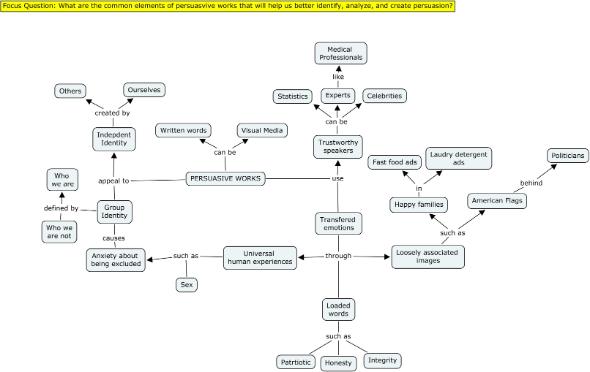
Concept Map
A teacher-created concept map of the concepts communicating in this learning series can be found below.